Effective heat management is a critical factor in modern engineering. Whether it's a high-performance semiconductor, an electric vehicle, or an industrial laser system, excessive heat can reduce efficiency, shorten component lifespan, and lead to system failures. This is why thermal conductivity plays a vital role when selecting engineering materials.
Thermal conductivity measures how efficiently a material transfers heat. Materials with higher thermal conductivity can dissipate heat more quickly, making them suitable for demanding industrial applications. Understanding the differences between commonly used engineering materials helps manufacturers choose the right solution for improved performance and reliability.
What is Thermal Conductivity?
Thermal conductivity is the ability of a material to conduct heat from one point to another. It is measured in watts per meter-kelvin (W/m·K). A material with a higher thermal conductivity value transfers heat faster, helping maintain stable operating temperatures in electronic and mechanical systems.
Thermal Conductivity Comparison
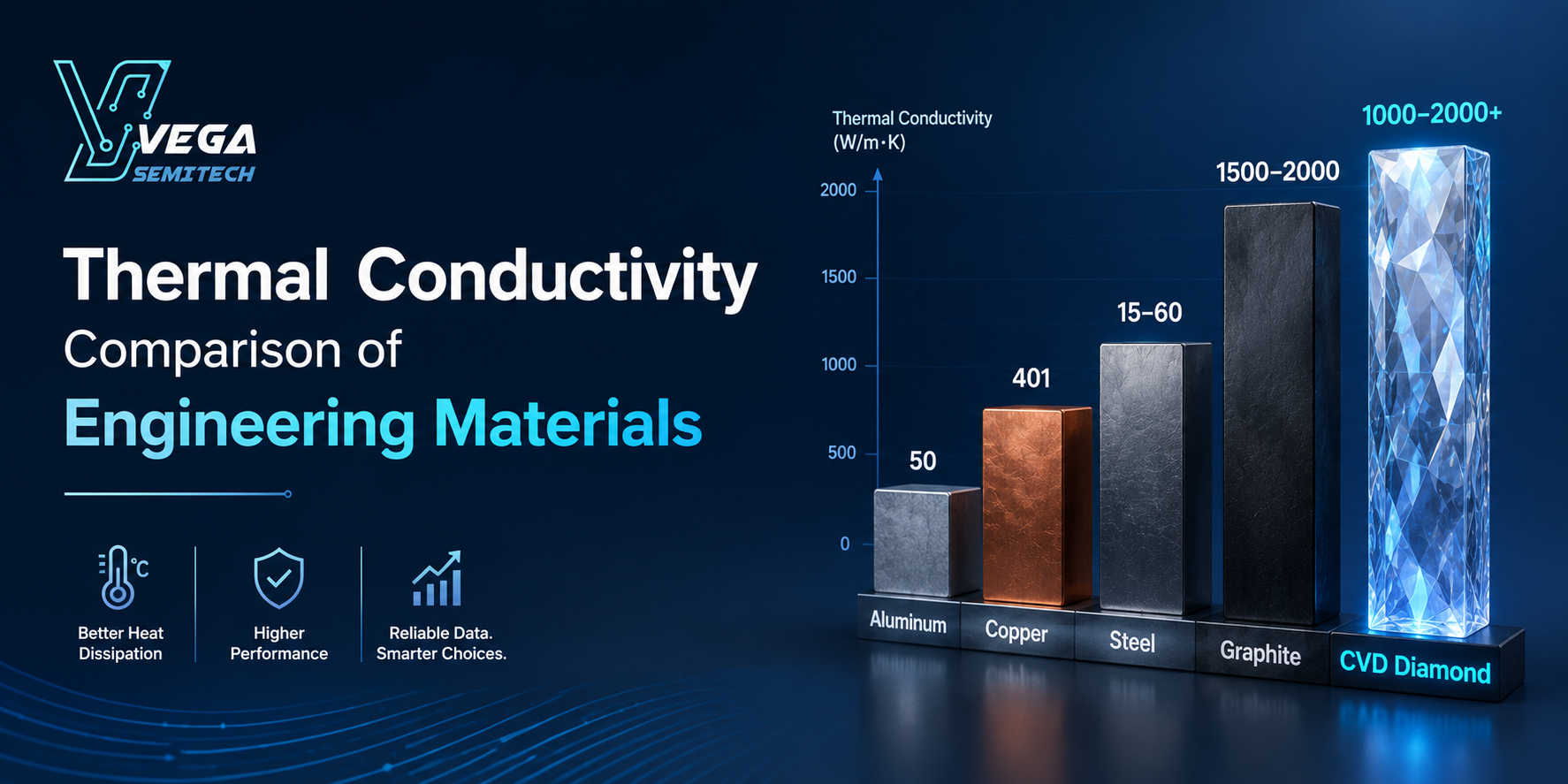
The table below compares the approximate thermal conductivity of commonly used engineering materials:
| Material | Approx. Thermal Conductivity (W/m·K) |
|---|---|
| CVD Diamond | 1,800–2,200 |
| Silver | 420–430 |
| Copper | 390–400 |
| Aluminum | 200–235 |
| Tungsten | 170–180 |
| Silicon | 130–150 |
| Alumina Ceramic | 20–35 |
| Stainless Steel | 15–20 |
| Glass | 0.8–1.2 |
The comparison clearly shows that CVD diamond offers significantly higher thermal conductivity than conventional engineering materials, making it one of the most effective solutions for advanced thermal management.
Why High Thermal Conductivity Matters
Selecting a material with excellent thermal conductivity provides several advantages for industrial and commercial applications.
- Faster heat dissipation.
- Improved equipment reliability.
- Enhanced energy efficiency.
- Longer component lifespan.
- Reduced risk of overheating.
- Better performance under high-power operation.
Applications of High Thermal Conductivity Materials
Semiconductor Manufacturing
Heat spreaders and substrates made from high-conductivity materials improve the efficiency, reliability, and lifespan of semiconductor devices used in modern electronics.
Power Electronics
Power modules, converters, and electric vehicle components generate substantial heat during operation. Efficient thermal management helps maintain stable performance and prevents component failure.
Laser and Optical Systems
High-power laser equipment requires materials capable of transferring heat quickly without affecting optical performance. CVD diamond is widely used because of its excellent thermal properties.
Aerospace and Defense
Aircraft, satellites, and defense systems operate under extreme conditions where efficient heat dissipation is essential for reliable and continuous performance.
Medical Equipment
Medical imaging devices, laser systems, and precision surgical instruments benefit from materials that provide outstanding thermal stability and durability.
Why CVD Diamond is the Preferred Choice
Among all engineering materials, CVD diamond stands out because it combines exceptional thermal conductivity with remarkable hardness, chemical resistance, and optical transparency. Unlike conventional metals, it efficiently transfers heat while maintaining excellent performance in harsh operating environments. These unique characteristics make it an ideal material for semiconductors, advanced electronics, aerospace systems, and emerging quantum technologies.
Conclusion
Choosing the right engineering material is essential for achieving optimal thermal performance. While copper, silver, and aluminum remain popular due to their excellent heat-conducting capabilities, CVD diamond offers unmatched thermal conductivity and superior overall performance. As industries continue developing more compact, powerful, and energy-efficient technologies, CVD diamonds will play an increasingly important role in advanced thermal management solutions.